
You eat the same meals you always have. You still walk three miles every morning. You haven't changed a single thing about your routine.
But something has changed about your body.
Your jeans fit differently. Your midsection has a softness that wasn't there two years ago. Your arms feel less toned, even though you never stopped your morning push-ups. And the number on your bathroom scale? It barely moved. Maybe three pounds. Maybe five.
So you tell yourself what everyone tells you: It's just aging. It's normal.
Except here's what nobody explains to you: your body isn't just gaining weight. It's replacing muscle with fat, storing it around your organs instead of under your skin, and slowing your metabolism by roughly 50 calories per day for every pound of muscle lost.
Your scale can't see any of this. It just shows a number.
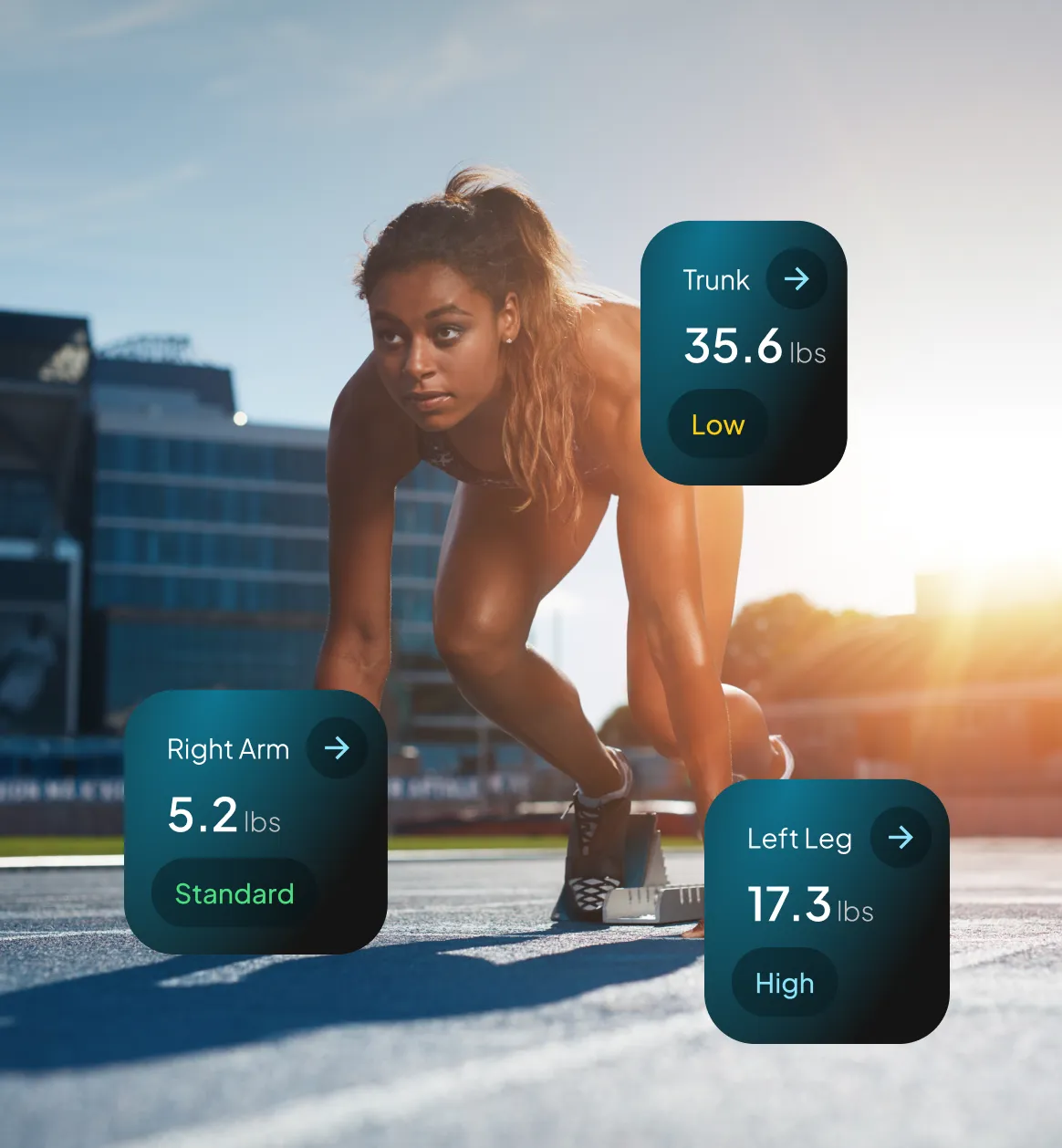
But a device originally designed for clinical research labs — one that measures 45 different metrics about what's actually happening inside your body — can.
Sound Familiar?
- Your weight hasn't changed much, but your body looks completely different
- The midsection softness started around 41 or 42 and won't respond to exercise
- You feel puffier — face, fingers, ankles — even when you're eating clean
- You're exhausted by 2pm despite sleeping 7-8 hours
- Your doctor says your labs are "fine" but you know something is off
- You've tried cutting carbs, intermittent fasting, and adding more cardio — nothing sticks
- Your arms and legs feel softer, less defined, even though you're active
If you checked three or more, you're not imagining things. And you're far from alone.
An estimated 50 million American women are currently in perimenopause or menopause. The average woman enters perimenopause at 40 and won't reach full menopause until 51. That's an eleven-year window where your body is fundamentally restructuring itself — and the tools most women use to track their health (a bathroom scale and an annual physical) were never designed to see it.
The Problem Isn't Willpower. It's Estrogen.
Here's what most women — and honestly, most doctors — don't explain clearly enough:
Starting in your late 30s, estrogen levels begin to decline. Not all at once. Gradually. Unevenly. Some months you feel fine. Other months your body feels like it belongs to someone else.
But here's what estrogen was quietly doing for decades that you never thought about:
1. Fat redistribution. Estrogen directed fat storage to your hips and thighs (subcutaneous fat). Without it, your body stores fat around your organs instead (visceral fat). Same weight. Completely different health risk.
2. Muscle loss acceleration. Estrogen protects skeletal muscle. As it drops, you lose roughly 1% of muscle mass per year — even if you're active. That's 5 pounds of fat-burning tissue gone by 45.
3. Metabolic slowdown. Less muscle = lower basal metabolic rate. You burn fewer calories at rest. The same meals that kept you at 135 now slowly push you toward 145.
4. Inflammation increase. Visceral fat isn't just stored energy. It's metabolically active. It produces inflammatory compounds linked to insulin resistance, cardiovascular disease, and accelerated aging.
This is why dieting harder doesn't work. You're not eating too much. You're losing the metabolic infrastructure that processed what you ate.
And a bathroom scale — the device that 87% of American women use to track their health — can't distinguish between a pound of muscle and a pound of visceral fat. It just shows a number that means almost nothing during this transition.
You need to see what's actually changing. Where the muscle is going. Where the fat is accumulating. How your metabolism is shifting week by week.
That's exactly what clinical body composition labs charge $150-$300 per visit to show you.
Or what one device, sitting on your bathroom floor, can show you every single morning in 60 seconds.
Meet the Hume Pod
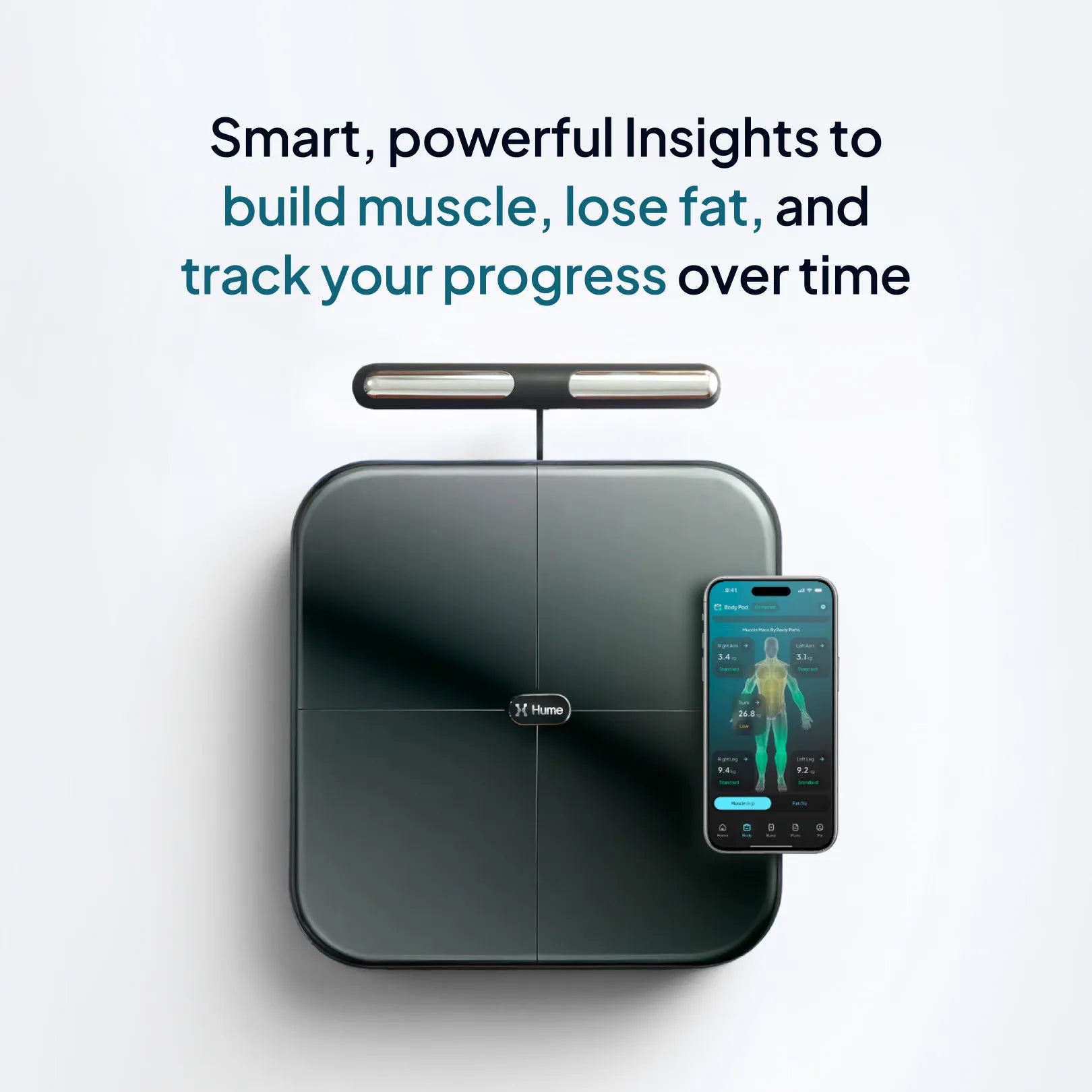
The Hume Pod is an 8-electrode body composition scale that uses the same multi-frequency bioelectrical impedance analysis (BIA) found in $10,000+ clinical machines — shrunk into a device that sits on your bathroom floor.
You step on. Grip the retractable hand electrodes. Wait 60 seconds. And get a complete picture of what's happening inside your body — not just your weight.
Here's what makes it different from every other "smart scale" on Amazon:
- 8 electrodes, not 4. Foot-only scales measure your lower body and guess the rest. The Hume Pod measures through your hands AND feet for full-body accuracy.
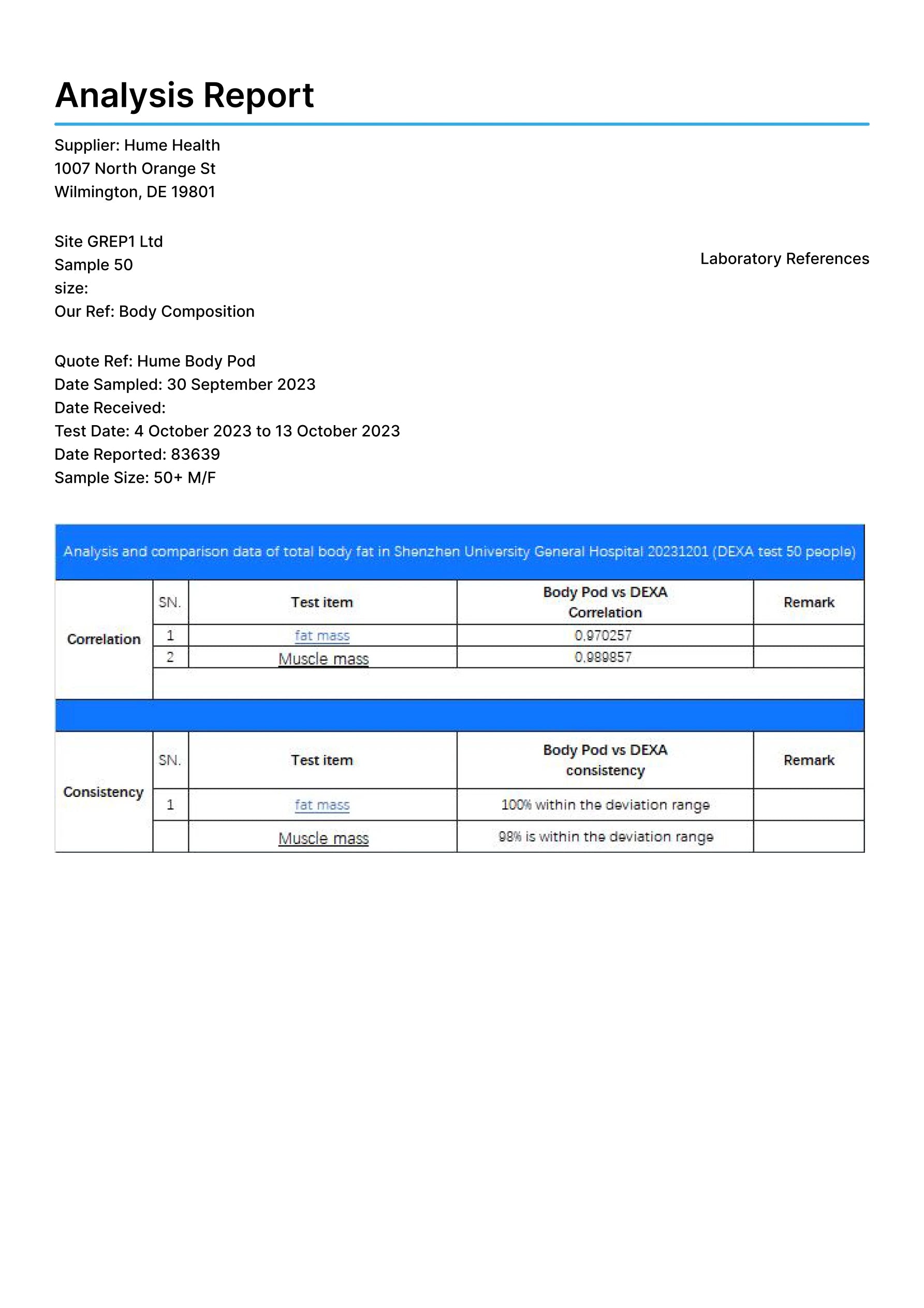
- 98% correlation with hospital DEXA scans. Independently validated by Socotech, not in-house testing.
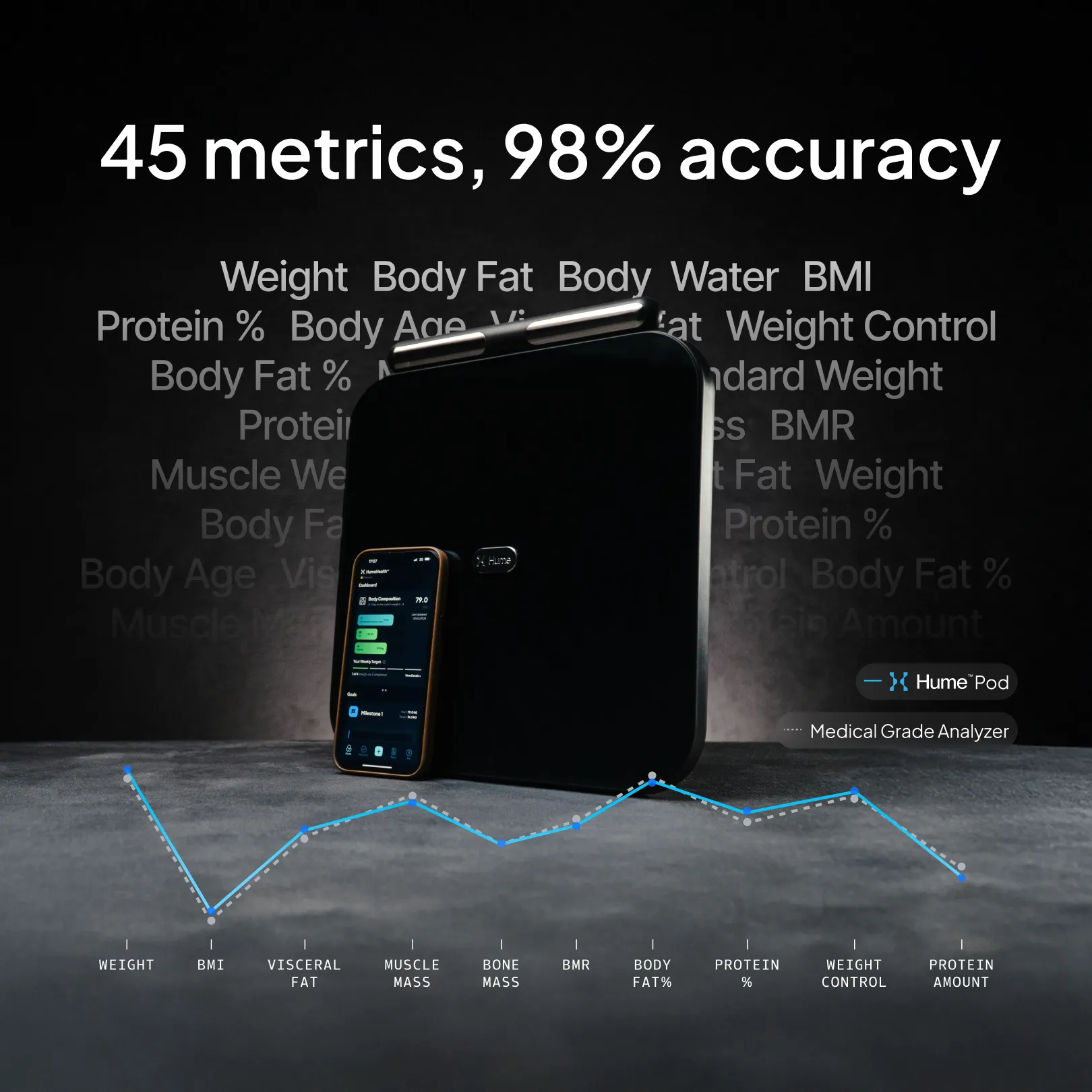
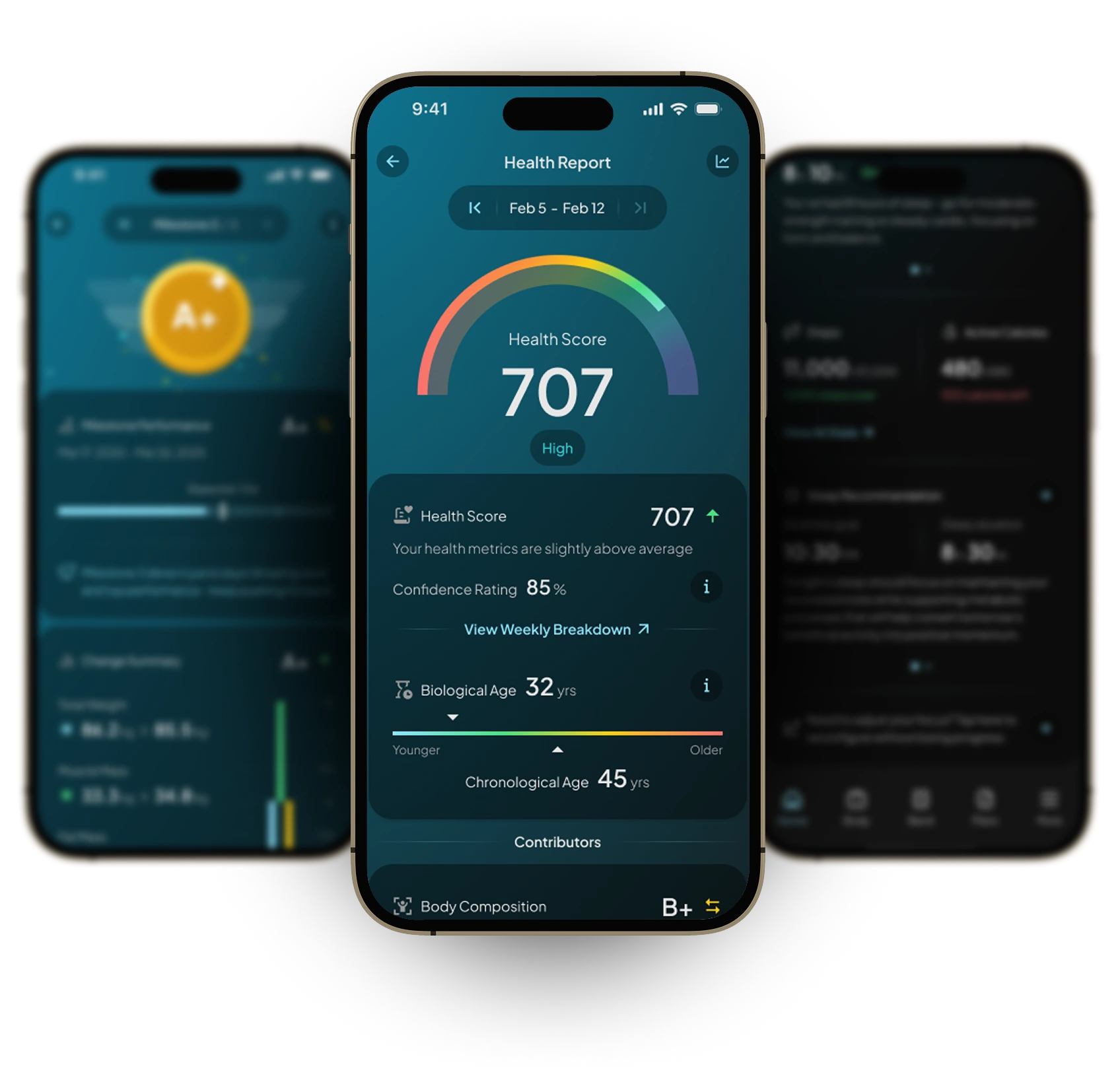
- 45+ metrics per scan. Body fat %, skeletal muscle mass, visceral fat level, metabolic age, bone density, segmental muscle balance, basal metabolic rate, body water %, and more.
- Zero subscription. Forever. Every feature in the app is free. No $15/month premium tier. No paywalled insights. One purchase, everything included.
Why Perimenopause Women Specifically Need This
Visceral Fat Tracking
See your visceral fat level daily — the dangerous organ fat that increases 2-3x during perimenopause. Your bathroom scale can't detect this. The Hume Pod measures it every morning.
Muscle Mass by Body Part
Segmental analysis shows exactly where you're losing muscle: left arm vs. right, upper body vs. lower. Perimenopause hits upper body muscle first for most women.
Metabolic Age Score
Your metabolic age is based on your basal metabolic rate compared to population averages. A 44-year-old with strong muscle mass might score as 37. A 44-year-old losing muscle without knowing it might score as 52.
Body Water Percentage
Estrogen decline reduces your body's ability to retain water. The result: puffiness, bloating, and that "swollen" feeling. The Hume Pod tracks your hydration balance daily so you can correlate it with your cycle and symptoms.
What Other Women Over 40 Are Saying
I'd been telling my husband for two years that something was wrong. My weight was 138 — basically the same as always. But I looked different. Felt different. My doctor said my labs were "within normal range." The Hume Pod showed me my visceral fat was at level 11 (should be under 9) and I'd lost 4 lbs of muscle since my last DEXA scan 18 months ago. I literally sat on my bathroom floor and cried. Not because the news was bad — because I finally had proof I wasn't imagining things. I started strength training that week. Three months later: visceral fat at 8, muscle mass up 2.6 lbs, metabolic age dropped from 51 to 44. Same weight on the scale. 138. But a completely different body.
✓ Verified BuyerMy daughter bought me one for Christmas and I honestly thought it was a glorified bathroom scale. Then I did my first scan and saw the segmental breakdown. My left side had noticeably less muscle than my right. My trainer confirmed I'd been compensating for a weak left hip for years. We adjusted my routine. Eight weeks later the imbalance had improved by 30%. I would have never known without this thing. Also — no subscription? In 2026? That alone sold me.
✓ Verified BuyerI almost didn't buy it because I was tired of "health gadgets" that end up in a drawer. But this is different because the data actually means something. I'm in perimenopause and my body has been doing weird things for the past year. The Hume Pod showed me I was retaining less water than normal (which explained the constant puffiness — counterintuitive, right?) and my metabolic age was 7 years older than my actual age. I took that data to my OB-GYN and she said it was the most useful patient data she'd seen from a home device. Taking off one star because the app could be prettier, but the data is worth every penny.
✓ Verified BuyerFormer DEXA scan devotee here. I was spending $175 every 3 months to track my body composition because my endocrinologist recommended it during perimenopause. That's $700/year. The Hume Pod cost me $229 on sale and I get daily scans that are within 1-2% of my last DEXA. I tested it — had a DEXA done the same day as my Hume Pod scan. Body fat: DEXA said 28.1%, Hume Pod said 27.6%. I literally cancelled my next DEXA appointment. My husband uses it now too. It recognizes us automatically.
✓ Verified BuyerWhat to Expect: Your First 8 Weeks
Based on aggregated data from Hume Pod users who started during perimenopause and added strength training 2-3x per week:


Hume Pod vs. What You're Probably Using Now
| Feature | Hume Pod | Bathroom Scale | DEXA Scan |
|---|---|---|---|
| Body fat % | ✓ | ✗ | ✓ |
| Visceral fat level | ✓ | ✗ | ✓ |
| Muscle mass by segment | ✓ | ✗ | ✓ |
| Metabolic age | ✓ | ✗ | ✗ |
| Body water % | ✓ | ✗ | ✗ |
| Daily tracking | ✓ Unlimited | Weight only | Quarterly visits |
| At home | ✓ | ✓ | Clinic only |
| Cost | $229 (sale) | $20-50 | $150-300/visit |
| Subscription | None. Ever. | None | Per-visit fee |
| DEXA accuracy | 98% correlation | N/A | Gold standard |
Trusted by world-class athletes and health professionals:





Belal Muhammad (2x UFC Champion) • Brianna McNeal (Olympic Runner) • Emily Loogman (3x CrossFit All-American) • Frank Gore (5x NFL Pro Bowl) • Tim Gray (Europe's #1 Biohacker)
"Body Composition Is the Vital Sign We've Been Ignoring in Women's Health"
Spring Sale: 40% Off the Hume Pod
For the first time this year, the Hume Pod is $229 (regularly $352). That's less than the cost of two DEXA scans — for unlimited daily scans, forever. No subscription. No hidden fees. One payment.

- 8-electrode full body scan
- 45+ metrics per scan
- Unlimited user profiles
- Free app forever — no subscription
- HSA / FSA eligible
- 45-day money-back guarantee
- Free shipping
HSA / FSA eligible • Free shipping • 45-day risk-free guarantee
That's $0.63/day for the first year. Less than a cup of coffee.
45-Day Money-Back Guarantee
Use the Hume Pod every day for 45 days. If you don't feel like you understand your body better than you ever have, return it for a full refund. No questions. No hoops. No restocking fees. We've shipped to 48,252+ customers. Our return rate is under 3%.
You're Not Imagining It. And You Don't Have to Accept It.
Perimenopause is not a disease. It's a transition. But it's a transition that changes your body in ways that are invisible to the tools most women rely on.
You're not crazy for feeling like something is different. You're not "just getting older." Your body is literally restructuring itself — moving fat to new places, breaking down muscle it spent decades building, rewiring your metabolism.
The women who navigate this transition best aren't the ones with the most willpower. They're the ones with the most data. They see what's changing. They know exactly which muscles are declining. They track their visceral fat weekly. They watch their metabolic age improve as they add strength training.
They stop guessing. They stop blaming themselves. They start managing the transition with real information.
And it starts with a 60-second scan on your bathroom floor, every morning, with a device that costs less than two DEXA appointments — currently $229, down from $352.
See What Your Scale Has Been Hiding
40% off ends Sunday. Hume Pod for $229 (regularly $352). No subscription. 45-day guarantee.
Get 40% Off — $229 →