

As Seen On
New York
Times WSJ
For GLP-1 weight loss users
Lost 40 Pounds On GLP-1? Make Sure It Was Fat, Not Muscle
A basic scale can celebrate the drop. It cannot tell you whether the weight came from fat, muscle, water, or the metabolic changes that may make maintenance harder later.
- See why GLP-1 users should track body composition, not just pounds.
- Learn the signs your progress may be coming from the wrong places.
- Use the 30-second Hume Pod scan routine to get clearer weekly feedback.
The hidden GLP-1 problem
The Scale Can Drop While Your Body Composition Gets Worse

GLP-1 medications can help people lose weight quickly. But quick weight loss can be hard to interpret if the only feedback you get is one number on the bathroom scale.
That number does not separate fat from muscle. It does not show hydration status. It does not warn you when your metabolic rate is trending in the wrong direction.
That is the kind of scan result that changes how people look at GLP-1 progress. The scale can make a drop feel like a clean win, while body composition shows whether lean mass, hydration, and metabolism are moving with it.
What to watch for
Signs Your GLP-1 Progress Needs A Closer Look

If any of these feel familiar, your next weigh-in may not be giving you enough information:
- You have lost weight fast, but feel weaker or softer than expected.
- Your appetite is lower, but you are not sure you are getting enough protein.
- Your hydration feels inconsistent, or your energy drops during the day.
- You want to stop guessing whether weekly weight loss is fat or muscle.
- You worry the weight could come back when your medication plan changes.
Why it happens
The Issue May Not Be Motivation. It May Be The Feedback Loop.

Most people on a GLP-1 do not need another lecture about discipline. They need better visibility.
When a scale says you lost four pounds, it hides the most important detail: what changed inside that four pounds. That is the One-Number Trap.
The target most people are trying to reduce.
The tissue many GLP-1 users want to protect.
The daily swing that can make progress hard to read.
Meet the scanner
Hume Pod Shows The Body Composition Story Behind Your Weight Loss

Hume Pod is an at-home body composition scanner designed to help you see what a basic scale cannot.
- Step on, grab the handles, and scan in about 30 seconds.
- Track 45 health and body composition metrics in the app.
- Follow fat, muscle, hydration, metabolic rate, and segmental trends.
Hume Pod is not a replacement for medical guidance. It is a clearer way to understand what your weight loss is made of, so your next steps are based on more than hope and a bathroom-scale number.
ContinueWhy it feels different
It Does Not Just Weigh You. It Separates The Signal From The Noise.

Hume Pod uses foot sensors and hand electrodes to help capture a fuller body composition picture, including arms, legs, and torso separately.
The app then color codes your metrics so you can quickly see what looks healthy, what needs attention, and where your trend is moving over time.
At-home routine
A Weekly Scan Can Turn Guesswork Into A Clearer Plan

The routine is simple: scan, spot what needs attention, adjust your habits, then check the trend again the next week.
- If muscle is trending down, prioritize protein and resistance training with your clinician's guidance.
- If hydration is low, stop guessing and watch the trend improve.
- If metabolic rate is dropping, catch it before the scale tells the whole story too late.
What users want to protect
For GLP-1 Users, The Win Is Not Just Losing Weight. It Is Losing Smarter.

Tracked metrics
See body composition context beyond pounds.
Body regions
Review arm, leg, and torso trends separately.
Fast scan
Build a repeatable home routine that is easy to keep.
"I stopped reacting to the scale and started watching the trend that mattered: fat down, muscle protected, hydration back on track."
Why the timing matters
More People Are Using GLP-1s. Fewer Know What The Scale Is Hiding.

GLP-1 weight loss can move quickly enough that waiting months for a clinic scan may leave you reacting late.
Hume Pod gives you a practical way to monitor trends more often at home, then bring better questions to your clinician, trainer, or nutrition plan.
Clinic footprint
Technology used across thousands of health clinic settings.
Eligible option
Availability can depend on plan rules and checkout details.
Eligible option
Confirm eligibility with your administrator before purchase.
Between appointments
Clinic Scans Are Helpful Snapshots. GLP-1 Weight Loss Changes Week By Week.
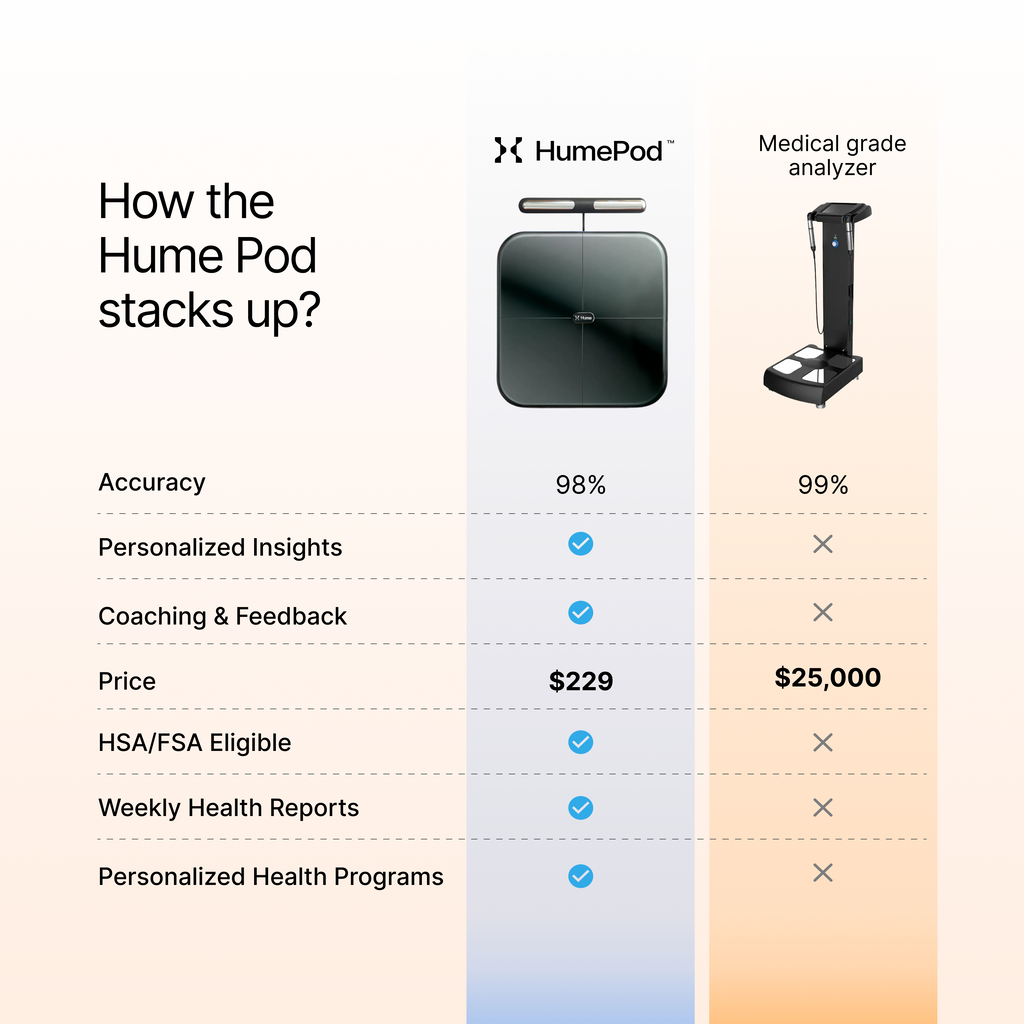
| Tracking need | Clinic scan | Hume Pod |
|---|---|---|
| Body composition context | Strong snapshot | Repeatable home trends |
| Weekly feedback | Appointment dependent | Designed for at-home scanning |
| What to improve | Often requires interpretation | App highlights metrics and next-step focus areas |
| Segmental view | Available in advanced scans | Arms, legs, and torso tracking in app |
Reader offer
Do Not Celebrate GLP-1 Weight Loss Until You Know What You Are Losing
For a limited time, Hume Pod is available with savings up to 40% off. Use it to track the metrics a normal scale leaves out.
- Save up to 40% today.
- May be HSA/FSA eligible depending on your plan.
- Track 45 metrics, including fat, muscle, hydration, metabolic rate, visceral fat, and body-region trends.
- Scan at home in about 30 seconds.
30-second check
Are You Currently Using Or Considering A GLP-1?
Start here so your tracking recommendation matches where you are in the process.
How Much Weight Have You Lost Or Expect To Lose?
The faster the change, the more important it becomes to know what kind of weight is changing.
What Are You Tracking Right Now?
If the answer is mostly scale weight, you may be missing the most important signal.
You May Be In The One-Number Trap
If you are losing weight on a GLP-1 but mostly tracking pounds, you may not know whether the change is coming from fat, muscle, water, or a mix of all three.
This page is sponsored by Hume Health. It is for informational purposes only and is not medical advice.