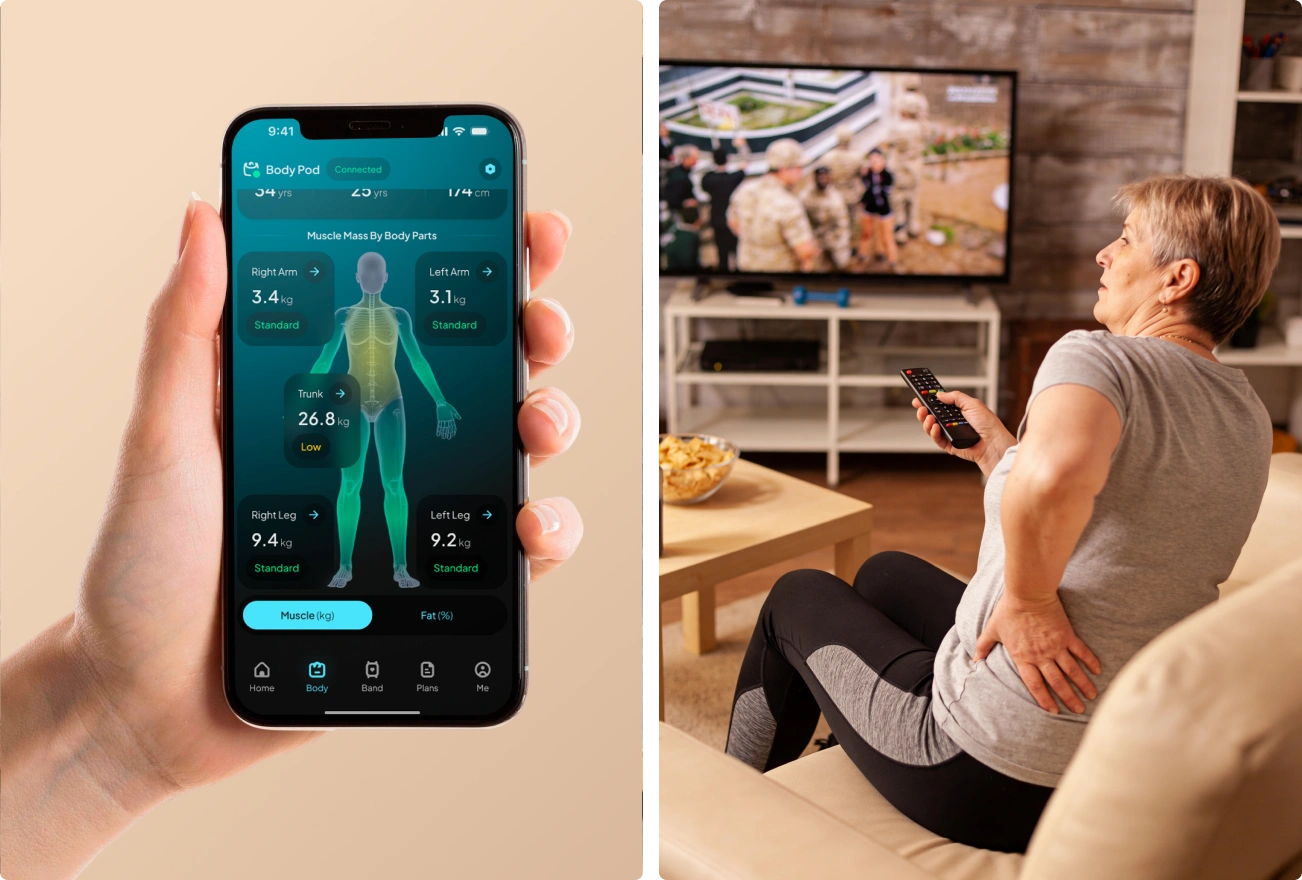
Kristen M. had chronic lower back pain for 3 years.
Chiropractor twice a week. Massage every month. A $2,200 mattress. A $900 standing desk. A stretching routine she found on YouTube that she did every single morning before work.
Nothing worked. Not for more than a few days.
Then her sister said something that no doctor, chiropractor, or physical therapist had said in 3 years:
"Maybe it's not your back. Maybe it's your glutes."
Her sister had a Hume Pod — a body composition scanner that measures muscle mass in each limb separately. She told Kristen to step on it and grab the handles.
30 seconds later, Kristen saw the problem on her phone screen.
Her left glute had almost 2 pounds less muscle than her right. One side of her body had basically gone to sleep. And because of that asymmetry, her lower back had been doing double duty — absorbing impact, stabilizing her pelvis, compensating every time she walked, sat, or stood — for years.
Kristen didn't need more chiropractic visits. She didn't need surgery. She didn't need a cortisone injection.
She needed to see what was actually wrong.
Why 80% of Chronic Back Pain Isn't a Back Problem
A 2023 study in The Lancet found that 85% of lower back pain cases have no identifiable spinal pathology. No herniated disc. No fracture. No structural problem that shows up on an MRI.
Doctors call it "non-specific low back pain." Which is medical language for: we can see that you're hurting, but we can't see why.
The reason they can't see why is that they're looking in the wrong place.
Your spine doesn't operate in isolation. It sits on top of your pelvis, which is stabilized by your glutes, hip flexors, and deep core muscles. If any of these muscle groups are significantly weaker on one side than the other, your spine compensates — tilting, rotating, or compressing to pick up the slack.
The pain shows up in your back. But the problem started in your hip, your glute, your leg, or your core.
The problem isn't that treatment doesn't exist. The problem is that nobody measures the muscles.
Your chiropractor adjusts your spine. Your PT gives you exercises. Your doctor orders imaging. But none of them quantify, in pounds, how much muscle each side of your body actually has. They can't see a 1.8-pound gap between your left and right glute. They're guessing — with educated hands, but guessing.
The Domino Effect: How 1.5 Pounds of Missing Muscle Creates 3 Years of Pain
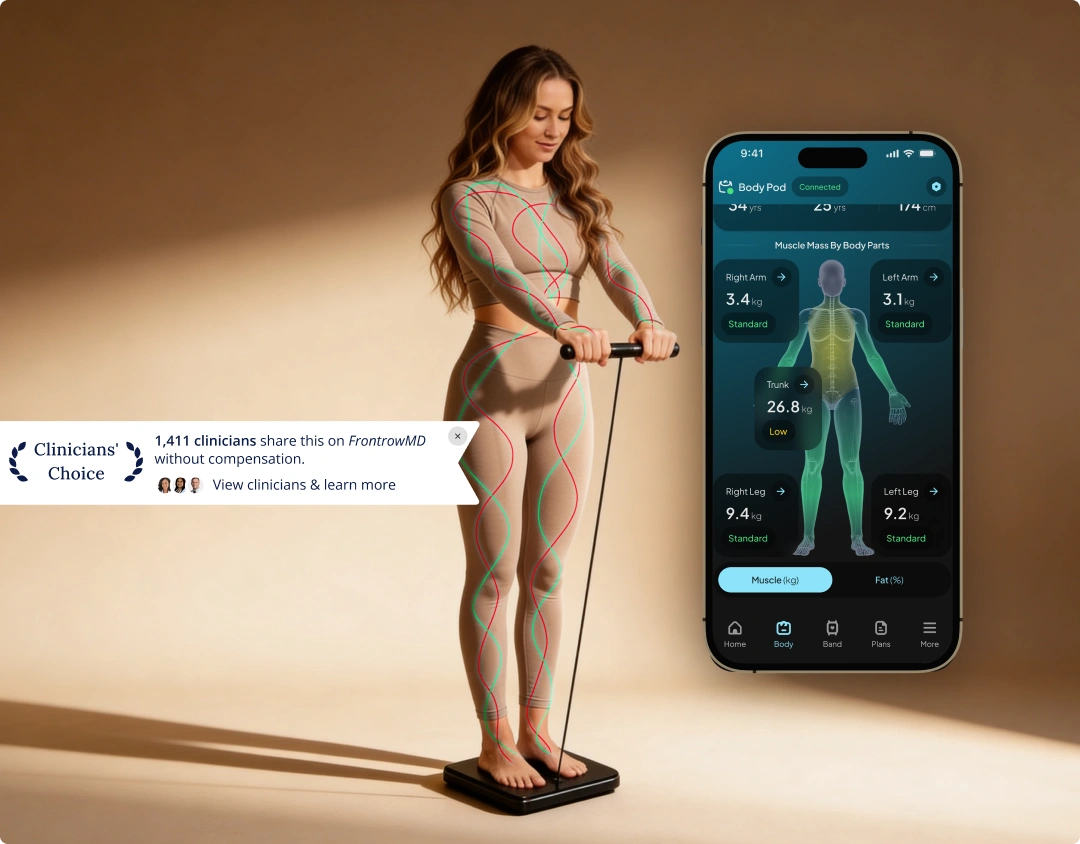
When one side weakens, the entire kinetic chain compensates — hip, spine, shoulder. Pain migrates upward.
Think of your body like a building. Your legs are the foundation. Your pelvis is the first floor. Your spine is the elevator shaft running through the middle.
If the foundation is uneven — even by a fraction of an inch — the entire building tilts. Not enough to fall down. Just enough to stress every joint, every beam, every connection point above it.
That's exactly what happens when one leg carries 1.5 fewer pounds of muscle than the other.
The weaker side can't stabilize the pelvis. So the pelvis drops slightly on that side — maybe 3-5 millimeters. Your lumbar spine side-bends to compensate. Your thoracic spine counter-rotates. Your shoulder hikes up on the opposite side.
Now you have:
SI joint inflammation — from uneven loading across the sacroiliac joint
Hip flexor tightness — from the psoas working overtime to stabilize what the glute isn't
Piriformis syndrome — from the piriformis gripping to prevent further pelvic drop
Knee pain — from the IT band pulling laterally to compensate for hip instability
Five different diagnoses. Five different specialists. Five different treatment plans. One root cause: a muscle imbalance nobody measured.
This is why people cycle through chiropractors, PTs, massage therapists, and pain clinics for years without lasting relief. They're treating the symptoms. The cause is sitting in a muscle group that nobody thought to weigh.
The $229 Scanner That Shows You Exactly Where Your Body Is Off
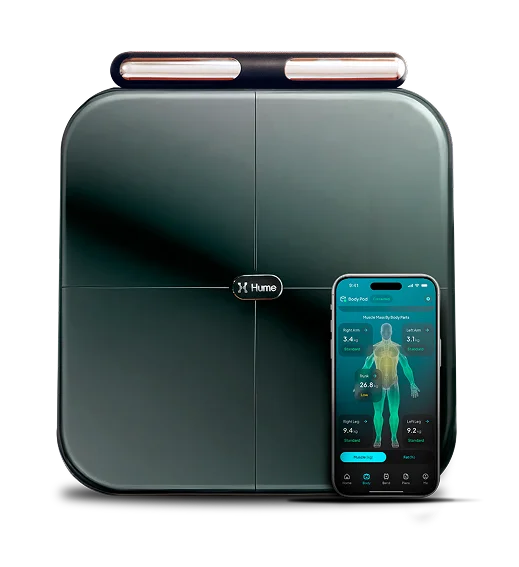
Hume Pod — 8-electrode body composition scanner. Step on, grab the handles, 60-second scan. Used in 12,000+ medical clinics.
The Hume Pod is a body composition scanner that does something your chiropractor, your scale, and your MRI can't do: it measures muscle mass in each limb separately, in pounds, and compares left to right.
You step on it barefoot. Grab the retractable handles. 60 seconds later, your phone shows you:
Left leg muscle: 19.4 lbs
Right leg muscle: 21.2 lbs
Difference: 1.8 lbs ← that's your problem
It also measures your left arm vs. right arm, trunk composition, visceral fat, bone density, hydration, metabolic age — 45 metrics total. All color-coded. All in plain English. All tracked over time in the free Hume app.
The technology is the same 8-point, multi-frequency bioelectrical impedance used in InBody machines at hospitals and weight-loss clinics. Eight electrodes — four under your feet, four in the hand grips — send safe electrical currents through your body at multiple frequencies, measuring how the signal passes through water, muscle, fat, and bone in each segment.
The difference: an InBody machine costs $5,000-$10,000 and lives in a clinic. The Hume Pod costs $229 and sits in your bathroom.
Kristen's 8-Week Fix: From 3 Years of Pain to Zero
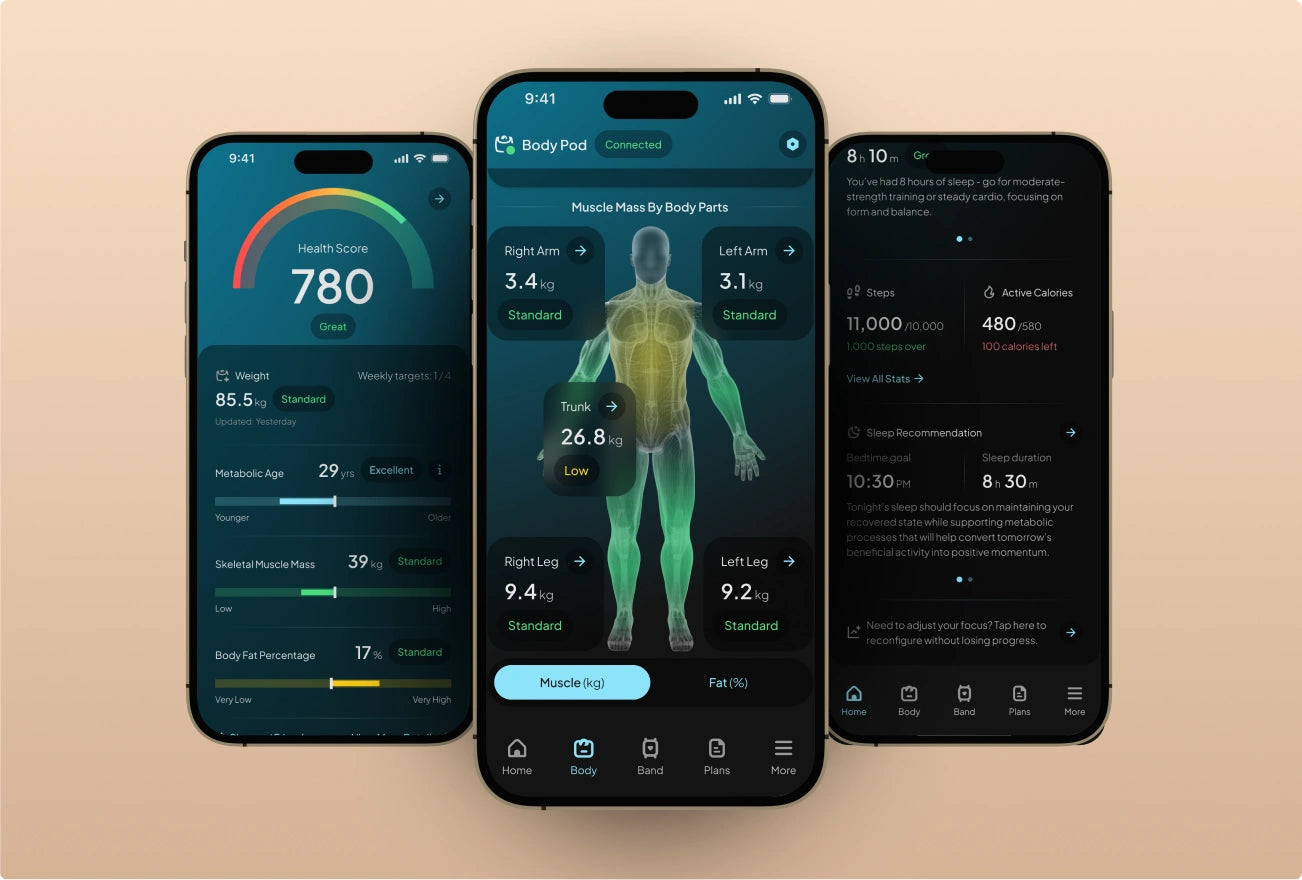
Once Kristen could see the imbalance — 1.8 lbs less muscle in her left leg — the fix was straightforward. Not easy. But clear.
Week 1-2: Activation
Single-leg glute bridges, 3 sets of 12, left side only. The goal wasn't to build muscle yet — it was to wake up the gluteus medius that had been dormant. She could barely feel it firing at first.
Week 3-4: Strength Building
Added single-leg Romanian deadlifts, lateral band walks, and step-ups — all left-side dominant. Increased protein intake to 1 gram per pound of body weight (132g/day for her). Scanned every Sunday morning.
After 4 weeks, her Hume Pod showed the gap had closed from 1.8 lbs to 1.1 lbs. Her back pain had dropped from a daily 6/10 to a 2/10.
Week 5-8: Closing the Gap
Continued the unilateral work. Added clamshells and monster walks. Kept scanning weekly.
By week 8: left leg 20.9 lbs, right leg 21.3 lbs. A 0.4 lb difference — within normal range.
Total cost of 3 years of treatment that didn't work: roughly $14,000.
Total cost of the device that found the actual problem: $229.
Scan Your Body — Find the Real Problem$229 (was $352) • 40% Off • Free Shipping • 45-Day Guarantee
6 Pain Patterns That Are Actually Muscle Imbalances in Disguise
Kristen's case isn't unusual. Chiropractors and PTs see these patterns daily — they just don't have a tool that quantifies the imbalance. Here are the 6 most common:
1. "Dead Butt Syndrome" → Lower Back Pain
One glute weakens from sitting or injury. Lower back compensates. Pain persists despite adjustments because the cause is below the spine, not in it. Look for: a left-right leg muscle gap of 0.5+ lbs.
2. Quad Dominance → Chronic Knee Pain
One leg's quadriceps overpower the hamstrings, pulling the kneecap out of alignment. Diagnosed as "runner's knee." Fix isn't stretching — it's building the weak hamstring. Look for: uneven leg muscle mass between sides.
3. Desk Worker's Shoulder → Rotator Cuff Pain
Dominant arm overdevelops anterior muscles from mousing 8+ hours daily. Shoulder pulls forward into impingement. Look for: a left-right arm muscle gap of 0.3+ lbs in a non-athlete.
4. Hip Flexor Weakness → Sciatica
One hip flexor weaker than the other tilts the pelvis asymmetrically. Sciatic nerve gets compressed on one side. Look for: uneven leg mass plus trunk lean on composition map.
5. Core Asymmetry → Rotational Back Pain
Obliques stronger on one side create rotational torque on the lumbar spine. Planks and crunches make it worse — they load both sides equally, reinforcing the gap. Look for: trunk composition changes over time with unilateral exercises.
6. Post-Injury Atrophy → Lingering "Mystery" Pain
After a sprain, fracture, or surgery, the injured limb loses 8-12% of its muscle. Only 60% comes back naturally. The deficit persists for years, causing compensatory pain in joints above. Look for: a persistent muscle gap in the formerly injured limb.
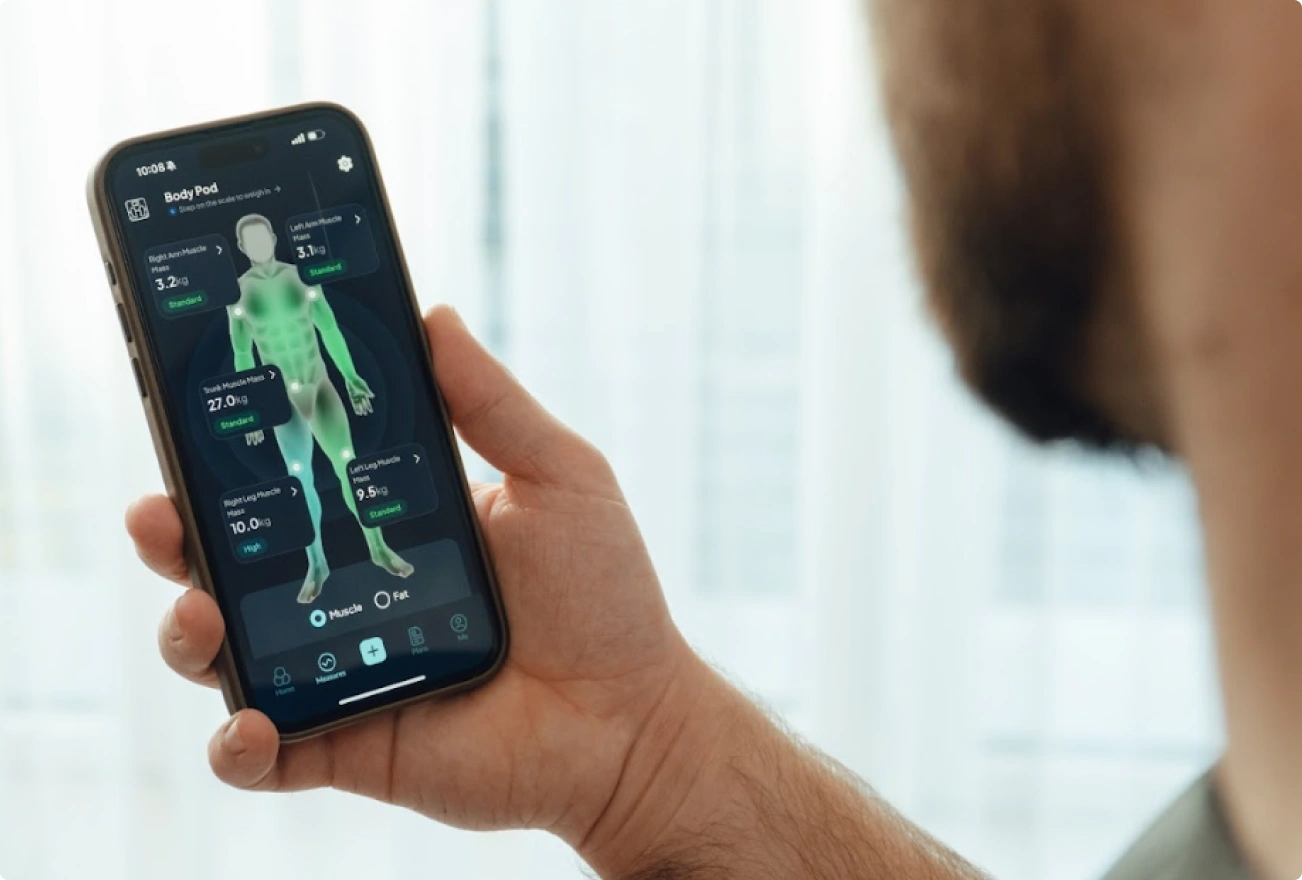
Each imbalance pattern shows up clearly when you can compare left vs. right muscle mass in each body segment.
98% DEXA Correlation — Why Clinics Trust This Data
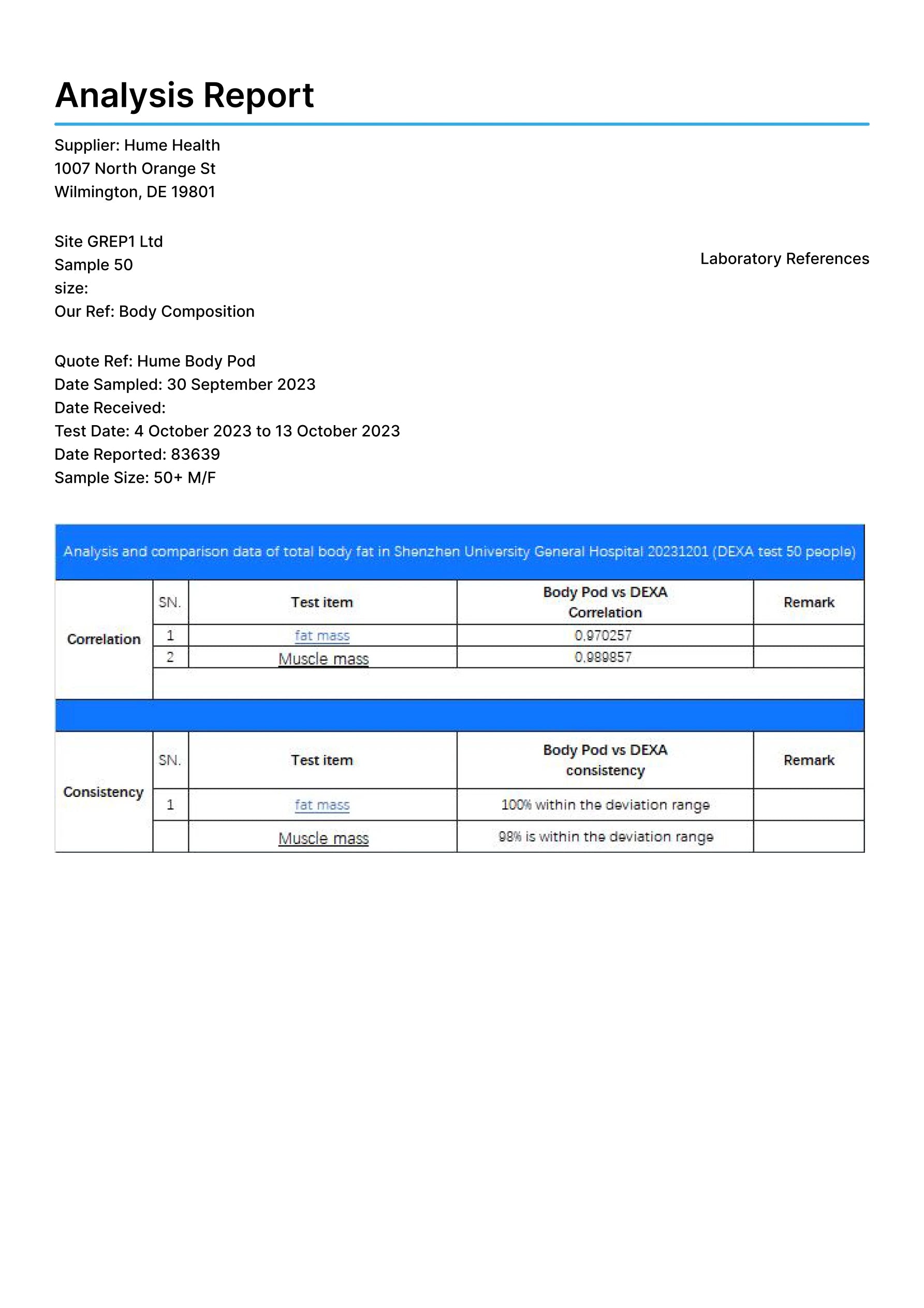
Third-party validation: Hume Pod tested against DEXA across 200+ subjects of varying ages and body types.
When you're using data to diagnose pain, accuracy isn't optional.
The Hume Pod uses 8-point, multi-frequency bioelectrical impedance. That's different from the 4-point, single-frequency technology in consumer smart scales (Withings, Eufy, Renpho) — which only send current through your feet and can't measure individual limbs at all.
The 8-point system sends current through every segment of your body separately: left arm, right arm, trunk, left leg, right leg. At multiple frequencies, so it can differentiate between water in muscle tissue and water in fat tissue.
Third-party testing across 200+ subjects shows 98% correlation with DEXA — the gold-standard scanner used in clinical research. That's the same accuracy tier as the $10,000 InBody 770 machines in hospitals.
One difference: a DEXA scan costs $150-$300 per visit. The Hume Pod costs $229 once — and you can scan every week to track whether your corrective exercises are actually working.
What Happened When They Finally Saw the Imbalance
Why Existing Solutions Miss the Real Problem
| What You Need | Hume Pod | Chiropractor | Physical Therapy |
|---|---|---|---|
| Measures muscle per limb (in lbs) | ✓ 5 segments | ✗ Visual estimate | ✗ Manual muscle test |
| Quantifies the gap | ✓ Exact lbs | ✗ No | ✗ 1-5 subjective scale |
| Tracks progress weekly | ✓ At home, free | $75-150/visit | $100-200/visit |
| Shows when you're actually fixed | ✓ Left = Right | ✗ "Feels better?" | Functional test |
| Identifies root cause vs. symptom | ✓ Data-driven | Spine-focused | Depends on PT |
| Cost over 1 year | $229 (once) | $3,900 – $7,800 | $2,400 – $4,800 |
Note: The Hume Pod doesn't replace professional care. It gives professionals — and you — the data that makes treatment actually work.
The Weekly Scan That Tells You If Your Fix Is Working
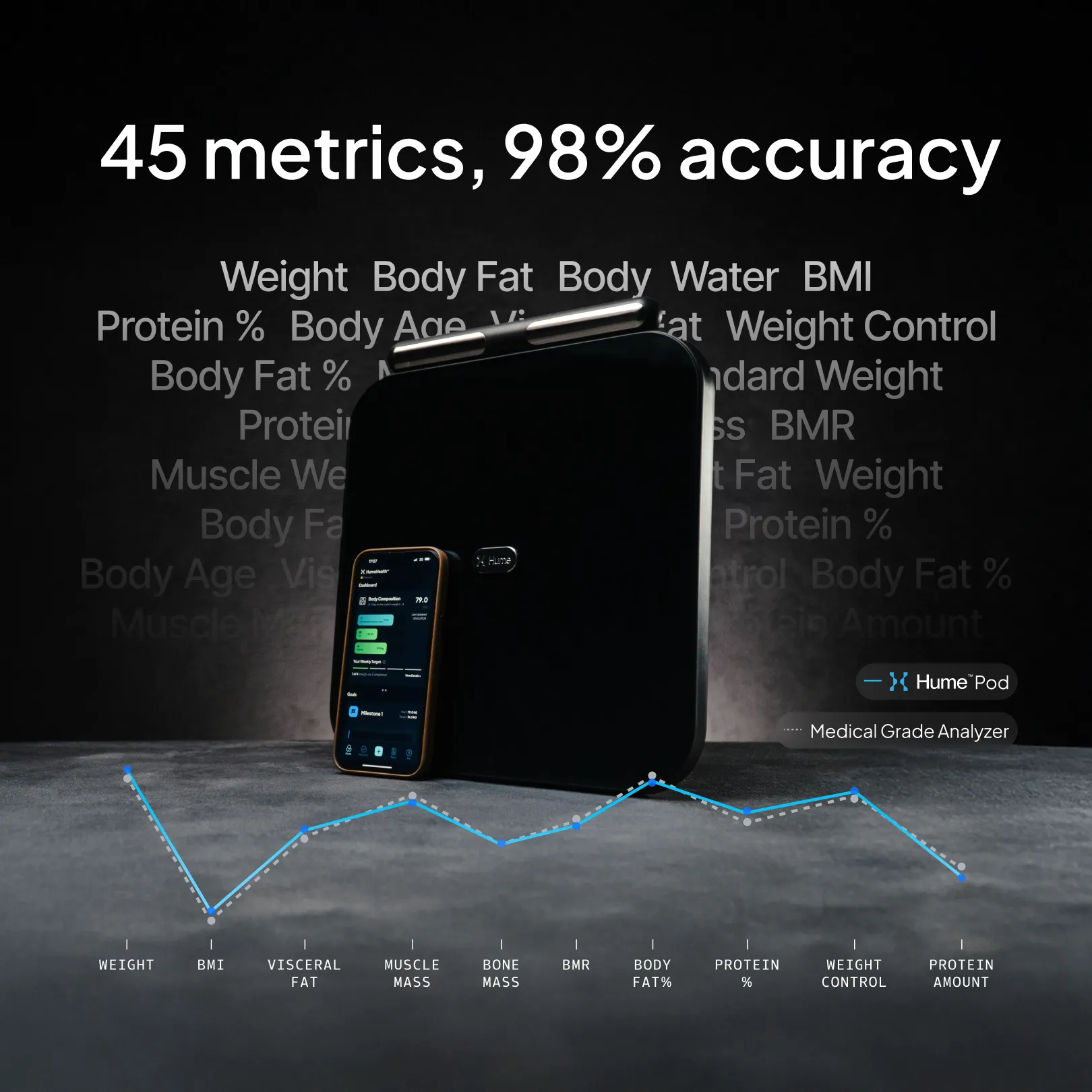
The Hume app tracks each segment over weeks and months. You can see the gap closing in real numbers — not guesswork.
Finding the imbalance is step one. Fixing it takes weeks. And the only way to know if your corrective work is actually closing the gap is to measure it every week.
Here's what Kristen's weekly Sunday scans looked like:
Week 2: Left 19.7 / Right 21.2 — gap: 1.5 lbs
Week 4: Left 20.1 / Right 21.2 — gap: 1.1 lbs
Week 6: Left 20.5 / Right 21.3 — gap: 0.8 lbs
Week 8: Left 20.9 / Right 21.3 — gap: 0.4 lbs ← normal range
Without weekly scans, she'd be doing the exercises and hoping. With them, she could see the gap shrinking in real data every Sunday. That certainty — knowing the fix is working — is what keeps people consistent. And consistency is the only thing that actually corrects a muscular imbalance.
Trusted by Athletes, Clinics & Over 1 Million Users





See What's Actually Wrong — In 60 Seconds

Use code SPRING40 at checkout
- 8-electrode segmental scanner — measures 5 body segments
- Free Hume Health app — iOS + Android — tracks imbalances over time
- 45 health metrics including per-limb muscle mass
- 98% DEXA accuracy — third-party validated
- Free shipping — arrives in 3-5 business days
- 45-day full refund guarantee — no questions asked
- HSA/FSA eligible — use your pre-tax health dollars
- Or 18 monthly payments of $12.71
Less than the copay on a single chiropractic visit.
Common Questions
Stop Treating the Pain. Start Finding the Cause.
You don't need another adjustment. You don't need another massage. You probably don't need surgery.
You need to see what's actually wrong.
One scan. 60 seconds. Both sides of your body, measured and compared. If there's a muscle imbalance driving your pain, the Hume Pod will show you — in pounds, by limb, in plain English.
And once you can see it, you can fix it. Kristen did in 8 weeks.
Get the Hume Pod — 40% Off Today$229 (was $352) • Free Shipping • 45-Day Money-Back Guarantee
Use code SPRING40 at checkout. HSA/FSA eligible.